


Flu
What is flu?
Flu is the upper respiratory tract infections caused specifically by influenza virus.
Influenza virus infection increases the risk of development of other infections, such as viral or bacterial pneumonia (inflammation of the lungs) that damages the lungs and which may result in a life-threatening complications. The following group of people is at a high risk of complications:
- Elderly people (65 years and above)
- Younger children
- People with chronic diseases of lungs or heart
- Patients with other chronic diseases whose immune system is weakened
- Healthy pregnant women, especially from the second half of pregnancy
Often any respiratory viral infections are called the flue, for example, the so-called “common cold” or “enterovirus”. However, we must keep in mind that these are different diseases and, unlike the flu, the progression and the complications of “common cold” or “enterovirus” are much lighter. It should also be noted that neither influenza vaccine nor antiviral therapy of flu are effective in this case (e.g. Tamiflu).
For more information about flu and its spread in Georgia, go to the link - Flu Epidsituation in Georgia
How to protect ourselves from infections?
It is possible to protect ourselves from flu and it involves certain measures to prevent virus from spreading.
- Wash your hands regularly
- Throw immediately a garbage container where you put the used napkins and / or handkerchiefs
- If you do not have a one-off handkerchief, sneeze or cough on the sleeve of the shirt and not on the hands
- Stay home if you feel that you are getting sick
- Regularly clean the surfaces of the objects and items that are touched by many people
- Get flu vaccination annually
How is flu spread?
Flu virus is transmitted through airborne droplets - during sneezing, coughing or by direct contact. The frequent way of transmitting flu virus is when we touch the surface where the small particles separated from the cough or sneezing of infected person are present and then we touch our eyes, mouth or the nose.
Infected person may be contagious even before the disease is revealed. Adults are contagious 1 day before detection of the disease and within 5 days after detection. Children are contagious for a longer period - up to 10 days.
What are flu symptoms?
- Rise in temperature
- Headache
- Muscle pain
- Very strong weakness
- Nasal congestion
- Sore throat
- Cough
Fever and other symptoms usually last for 7-10 days. Cough and weakness can be extended to 1-2 weeks and more.
How to take care of ourselves at home?
Upon detection of symptoms:
- Stay at home in a relaxed condition (remain at bed rest)
- Drink plenty of fluids (for filling fluid loss due to fever)
- Do not smoke and ask others not to smoke in the house
- Breathe the moist air to clean the blocked nose. To do this, pour hot water in the reservoir and breathe the steam.
- Your may receive an antiviral therapy (e.g. Tamiflu) at the doctor's prescription, but you should start it within first 48 hours after symptoms appear.
- You may also take non- prescription medicines - Acetaminophen (e.g. Tylenol) or Ibuprofen (e.g. Nurofen). Keep in mind that these medicines should be taken by children under 6 only after consultation with the pediatrician.
- It is not permitted to prescribe aspirin to patients under the age of 18 , because of the risk of developing Reye's syndrome, which may result in a significant deterioration in health (including convulsions, drowsiness, lethargy, strong vomiting, diarrhea, change of consciousness and behavior, disorientation, hallucinations).
- If you have flu symptoms and you are in a high risk group of complications
- If your condition is getting worse, namely: dyspnea, air deficiency, pain in the chest, have signs of dehydration - reduced urination and / or dizziness.
When should we apply to medical institution?
- If you have flu symptoms and you are in a high risk group of complications
- If your condition is getting worse, namely: dyspnea, air deficiency, pain in the chest, have signs of dehydration - reduced urination and / or dizziness.
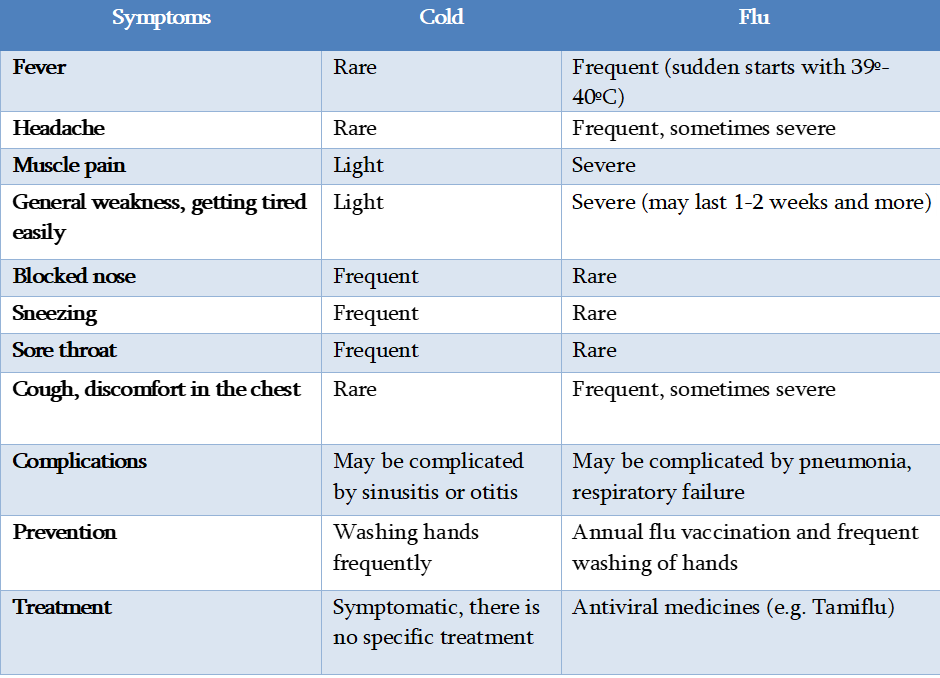
What is the difference between cold and flu?
We must remember that “cold” and flu are different diseases. Unlike the flu, the “cold” process and complications are much lighter.
How to distinguish the flu from cold?
What is flu vaccination and why should we get vaccinated?
Annual flu vaccination is the most efficient and safe method for the prevention of the flu. During the vaccination, the human organism is infected with the inactive (dead) virus, which naturally does not cause the disease, but stimulates the formation of antibodies to the flu viruses.
What are the arguments of the opponents to the vaccination?
Opponents to vaccination do not rely on facts, but rely on myths, namely:
- Myth: flu is not a serious disease
- Fact: hundreds of people die during annual seasonal flu spread even in the developed countries. Fatal outcome is particularly marked in high-risk patients (over 65 years old, in small children, etc.)
- Myth: vaccine may have complications or side effects
- Fact: flu vaccination is safe. The redness and pain in the injection are is often observed. Sometimes it may cause a moderate head and / or muscle pain and general weakness.
- Myth: annual vaccination reduces immune system. Vaccination made in the past years is enough.
- Fact: virus strains differ in each season. That is why annual vaccination against the expected strains is necessary.
- Myth: I am allergic and can not be vaccinated.
- Fact: Most of allergic patients tolerate flu vaccines well. It is also established that people, who are allergic to eggs can be vaccinated safely. If necessary, allergic tests can be made before vaccination.
- Myth: vaccination is not effective. Last year, I was vaccinated, but got sick anyway.
- Fact: Flu vaccination does not prevent other respiratory viral or bacterial infections, such as “cold” or “enterovirus” because they are not caused by a flu virus. The so-called “cold” or "enterovirus" are relatively mild diseases, and they do not have fatal complications. Flu vaccine prevents only occurrence of severe respiratory infections, such as influenza, and in case of disease development - it progresses mildly.
- Myth: vaccination is not permitted during pregnancy
- Fact: it is established that the flu vaccination is absolutely safe for pregnant women. On the contrary, the second half of pregnancy belongs to the high risk period and the vaccination is strongly recommended.
- Myth: vaccination is not recommended during breast-feeding
- Fact: It is established that vaccination is absolutely safe for breastfeeding mothers as well as for nursing newborns.
What is the difference between vaccines and antiviral medications?
Vaccination is carried out to prevent the development of flu, if contacted with the causative virus. Vaccination fortifies the immune system of the body to the specific type of virus.
In contrast to the vaccine, antiviral medicines are remedies for the treatment of a person already suffering from the disease. They kill the virus in the body. Therefore, antiviral drugs can not replace the vaccine.
What is Tamiflu?
Tamiflu (Oseltamivir) is an antiviral medication for oral intake. It shows the activity to all clinically significant influenza viruses. The mechanism of its action is to suppress the effect of neuraminidase on the surface of the flu virus, which prevents the spread of the virus in other cells. The Tamiflu first appeared on the market 19 years ago and since then, more than 90 million patients, including 30 million children, in around 80 countries around the world, including in USA, Japan, Canada, Australia, the European Union, Switzerland and South American countries have been treated by Tamiflu.
When is Tamiflu prescribed?
Tamiflu is indicated for the treatment of influenza of A and B type viruses of patients from the age of two weeks and in some cases for patients over 1 year for the prevention of influenza. Tamiflu is the only antiviral medicine that is recommended for infants from 2 weeks of age.
Is prescribed Tamiflu to pregnant women?
On the recommendations of the American Disease Control and Prevention Center (CDC), pregnant women should be treated with antiviral drugs Tamiflu, as the outcome of flu may be much serious and dangerous for a pregnant patient. Tamiflu is prescribed to the pregnant women only by medical prescription.
For more information go to the link: http://www.flu.gov/individualfamily/parents/pregnant5tips.html
How to take Tamiflu?
Tamiflu is taken only by medical prescription, in the form of capsule (75 mg) by oral intake. The dose of Tamiflu in adults is 75 mg twice daily for 5 days. In case of contact with the virus, the prophylactic dose is 1 capsule once a day, which can be taken up to 6 weeks. One package of Tamiflu contains 10 capsules for the full course of treatment. For the achievement of the maximum effect, it is necessary to start treatment within 48 hours after the manifestation of the symptoms.
The dosage scheme in children is different and is administered by calculating the kilogram weight (for the correct dosage consult the pediatrician).
Effectiveness of Tamiflu
The use of Tamiflu by the approved regime of dosage is accompanied by a reduction of severity of symptoms by 38%, reduction of secondary complications (bronchitis, pneumonia and sinusitis) in otherwise healthy individuals by 67%, a reduction of flu duration by 37%.
Based on numerous observations, early treatment with Tamiflu significantly reduces the duration and severity of the disease, the risk of complications, the mortality, the need for hospitalization. It is effective during both light and severe illness, in outpatient and hospitalized, immunocompromised and pregnant patients. It also reduces the isolation and the potential for spreading the virus.
What are the side effects of Tamiflu?
Any medication may have a risk of side effects.
The most frequent side effects of Tamiflu are vomiting and nausea. Most of these cases were reported once or on the first-second day of treatment and were usually eliminated within 1-2 days. These side effects can be reduced by taking Tamiflu with food. When taking the medicine may also result in the development of abdominal pain, nose bleeding, headache and general weakness.
Full information about Tamiflu can be found on Georgian Drug Agency's website: search for medicines
Full information about Tamiflu can also be found on the following pages of Drug Regulatory Agencies of Europe and the USA:


